IMAGE

FIGURE 1

ID
ZDB-IMAGE-241213-42
Source
Figures for Chan et al., 2024
Image
Figure Caption

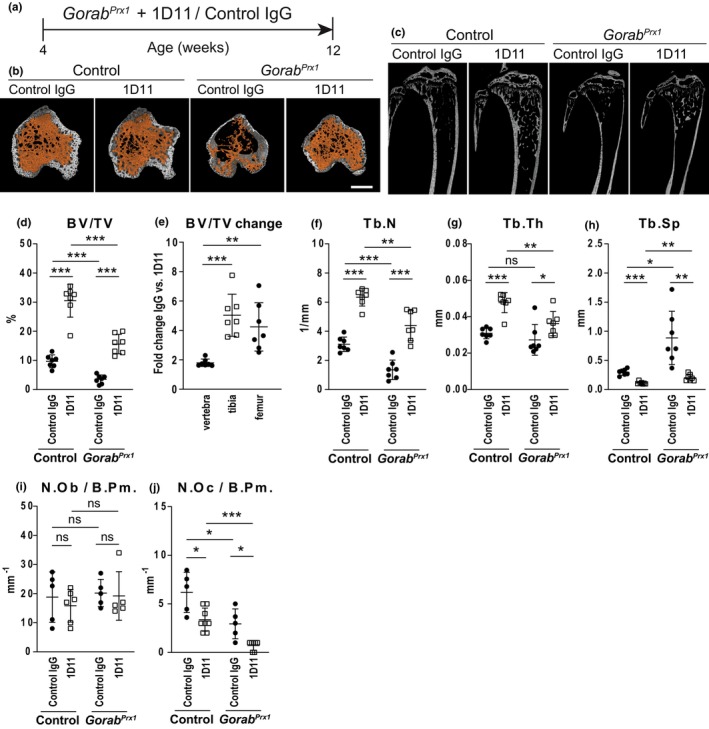
FIGURE 1

Gorab‐deficient long bones are more sensitive to TGF‐β inhibition than the Gorab‐expressing axial skeleton. (a) Treatment scheme for the GorabPrx1 mice. 4 weeks old GorabPrx1 mice were injected with 10 mg/kg body weight of either control IgG or 1D11 thrice a week by intraperitoneal injection for 8 weeks. (b) 3D rendering and (c) Representative microCT images showing the proximal tibia of control and GorabPrx1 mice treated with control IgG or 1D11. Scale bar = 500 μm. Quantitation of (d) percentage of trabecular bone volume (BV/TV); (e) comparison of rescue effects in vertebrae, tibia, and femur; (f) trabecular number (Tb.N); (g) trabecular thickness (Tb.Th); and (h) trabecular separation (Tb.Sp) in proximal tibia of control IgG and 1D11 treated control and GorabPrx1 mice (N = 7). Scanned and analyzed with Scanco μCT40 at 10 μm. Histomorphometric analysis at the proximal tibia secondary spongiosa in control and 1D11 treated GorabPrx1 mutants for (i) number of osteoblasts per bone perimeter (N.Ob/B.Pm); and (j) number of osteoclasts per bone perimeter (N.Oc/B.Pm). (N = 5–6). *p < 0.05, **p < 0.01, ***p < 0.001, ns, no statistically significant difference (unpaired Welch's t‐test).

Acknowledgments
This image is the copyrighted work of the attributed author or publisher, and ZFIN has permission only to display this image to its users. Additional permissions should be obtained from the applicable author or publisher of the image. Full text @ Aging Cell