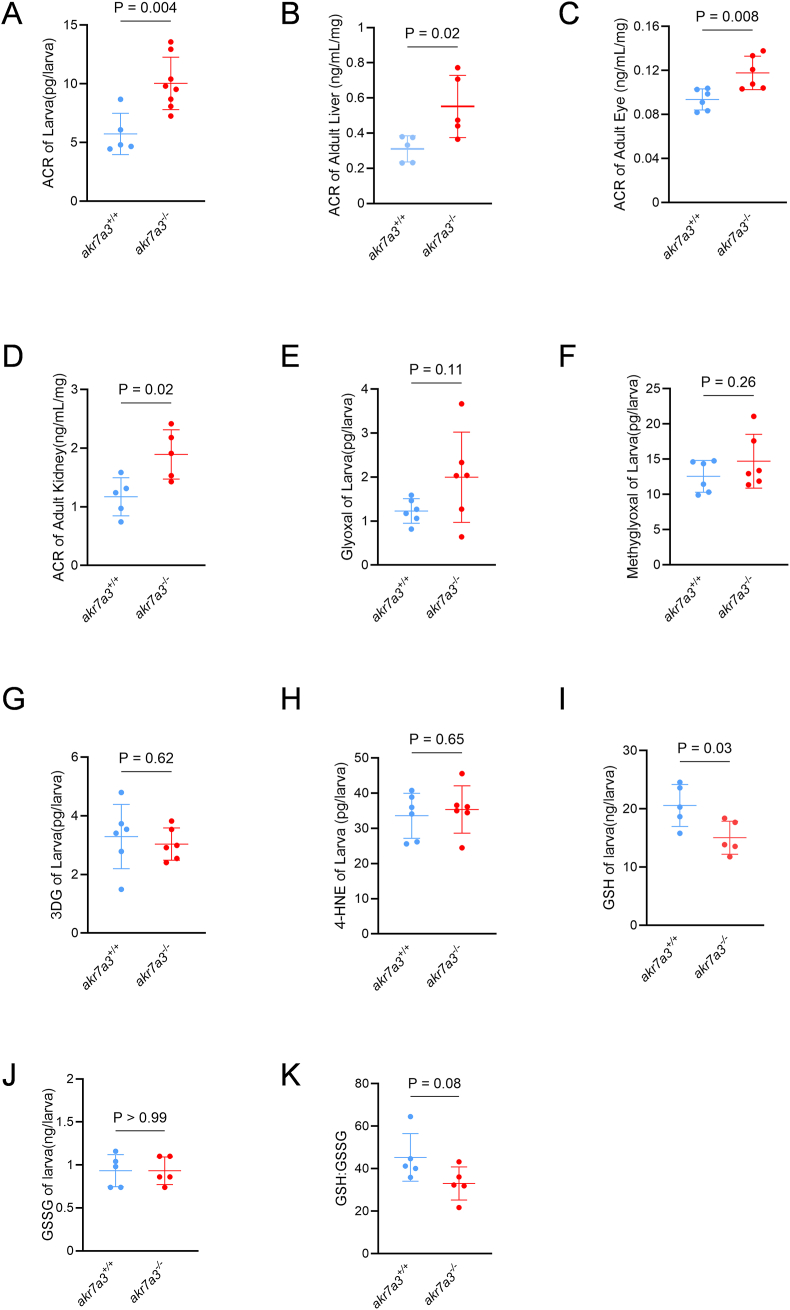
Endogenous ACR was accumulated in akr7a3−/− mutant zebrafish. (A–D) ELISA determination indicated that ACR was significantly increased in 96 hpf old akr7a3−/− larvae (A) and in adult akr7a3−/− liver (B), akr7a3−/− eye (C), and akr7a3−/− kidney (D). Each data point indicates 47–50 larvae per clutch or one adult zebrafish organ, n = 5–8. (E–H) Representative RCS quantification by mass spectrometry or ELISA. The concentration of glyoxal (E), methylglyoxal (F), 3DG (G), and 4-HNE (H) remained unaltered in akr7a3−/− larvae. Each data point indicates 47–50 larvae per clutch, n = 6. (I–K) Quantification of GSH and GSSG revealed a significant decrease in GSH in 5 dpf old akr7a3−/− larvae (I), while GSSG (J) levels and the GSH/GSSG ratio (K) remained unchanged. Data represent 50 larvae per clutch, n = 5. The bars indicate mean ± SD values. Statistical analysis was performed by Student's t-test. ACR, acrolein; 3DG, 3-Deoxyglucosone; 4-Hydroxynonenal, 4-HNE; GSH, glutathione; GSSG, glutathione disulfide.
This image is the copyrighted work of the attributed author or publisher, and
ZFIN has permission only to display this image to its users.
Additional permissions should be obtained from the applicable author or publisher of the image.
Full text @ Redox Biol.
Your Input Welcome
Thank you for submitting comments. Your input has been emailed to ZFIN curators who may contact you if
additional information is required.
Oops. Something went wrong. Please try again later.