
Fig. 4
- ID
- ZDB-IMAGE-260723-42
- Publication
- Kaveh et al., 2026 - Flow-mediated endothelial remodeling and inflammation drive developmental vascular susceptibility in ldlr loss of function
- All Figures
- Figures for Kaveh et al., 2026
|
Fig. 4
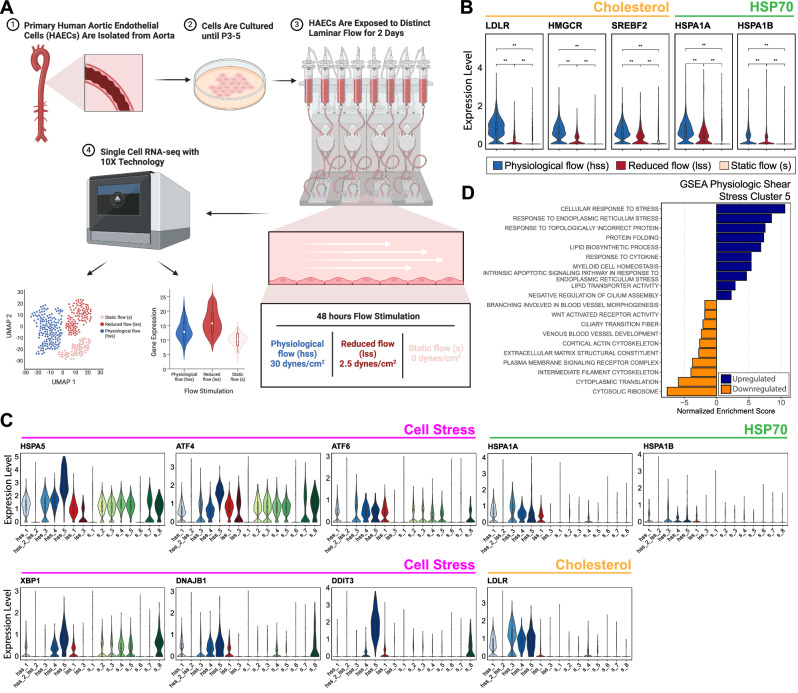
scRNA-sequencing of flow-modulated human aortic endothelial cells identifies preferential upregulation of LDLR and HSP70 under physiological flow, with heterogenous activation of other cell stress pathways.
A Schematic of human aortic endothelial cell (HAEC) culture and scRNA-seq workflow following exposure to physiological flow (30 dynes/cm2; high shear stress, hss), reduced flow (2.5 dynes/cm2; low shear stress, lss) or static (0 dynes/cm2; s) flow conditions. Created in BioRender. Salazar, A. (2026) https://BioRender.com/8cz4xxd. A total of 10,083 HAECs were processed in a single batch. B Violin plots of normalized LDLR, HMGCR, SREBF2, HSPA1A and HSPA1B expression across flow conditions. Each violin represents single-cell expression values, the central line indicates the median, and the shape represents the kernel distribution. Two-tailed Wilcoxon rank sum test and Bonferroni’s multiple comparison test used. ** p < 0.01. C Violin plots of normalized LDLR, HSPA1A, HSPA1B, HSPA5, ATF4, ATF6, XBP1, DNAJB1 and DDIT3 expression across HAEC clusters under physiological (hss), reduced (lss) and static (s) flow conditions. D Gene set enrichment analysis (GSEA) of HAEC physiological (hss) cluster 5 showing significantly upregulated and downregulated pathways.