
Fig. 3
- ID
- ZDB-FIG-221006-14
- Publication
- Venincasa et al., 2021 - Elevated preoptic brain activity in zebrafish glial glycine transporter mutants is linked to lethargy-like behaviors and delayed emergence from anesthesia
- Other Figures
- All Figure Page
- Back to All Figure Page
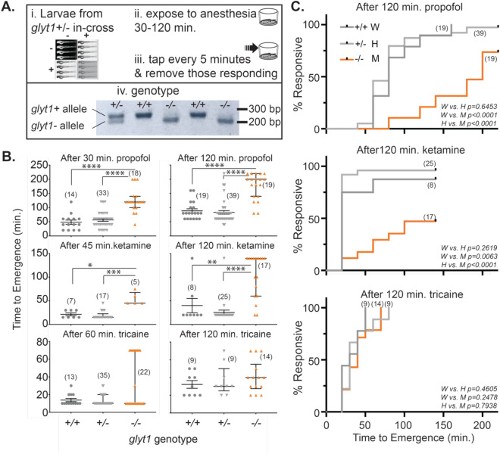
glyt1−/− mutant zebrafish larvae show delayed emergence from anesthesia. (A) Experimental workflow is indicated. i-Progeny from glyt1 ± adult in-cross were raised for five days and ii-transiently exposed to one of three anesthetics:10 µM propofol, ketamine (20 mM 45 min. or 10 mM 120 min.) and buffered 765.4 µM tricaine. iii-After removal of anesthetic, time of first response to vibration (stimuli were delivered at five-minute intervals) was recorded and iv-individual genotypes were subsequently determined using a PCR/restriction enzyme-based assay. A representative, cropped image of the genotyping gel with each lane corresponding to a larvae is shown. (B) Scatter plots of individual emergence times are overlaid with median and interquartile range. Kruskal Wallis ANOVAs followed by Dunn’s multiple comparisons were conducted for each anesthetic and incubation time. Asterisks indicate p-value: *p < 0.05, **p < 0.001, ***p < 0.001, ****p < 0.0001. Compared to their siblings, glyt1−/− mutants took more than twice as long to emerge from both ketamine and propofol. By contrast, glyt1−/− mutants and their siblings took similar amounts of time to emerge from tricaine. (C) Kaplan–Meier plots of the proportions of responsive fish against time-post-anesthesia for the same glyt1 + / + , glyt1 + /-, and glyt1−/− larvae presented in B are shown post-120-min exposures to propofol (top), ketamine (middle), and tricaine (bottom). p-values are calculated using log rank tests. |
| Fish: | |
|---|---|
| Conditions: | |
| Observed In: | |
| Stage: | Day 5 |