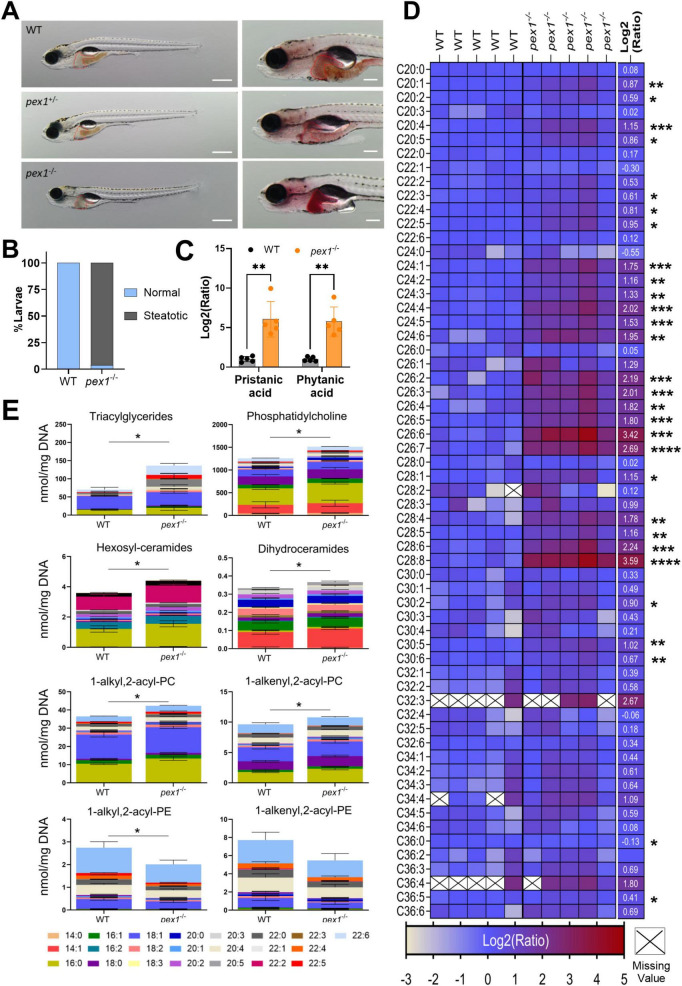
Liver steatosis and lipid dyshomeostasis manifest during early development in pex1 mutant larvae. (A) Brightfield (left) and Oil-Red O (ORO) staining (right) of 13 dpf zebrafish larvae. Robust neutral-lipid accumulation is confined to the liver of pex1–/– larvae compared with wild-type (WT) and heterozygous siblings. Scale bar, 1 mm. (B) Incidence of ORO-positive (steatotic) livers at 13 dpf; n = 20 larvae per genotype. (C) Log2 fold change of pristanic and phytanic acid in pex1–/– versus WT larvae at 13 dpf measured by LC-MS in whole-larva extracts. Bars represent means ± SDs of five independent replicates, each replicate being a pool of five larvae (n = 5). (D) Heatmap of fatty acid (FA) species profiled by LC-MS. Columns represent biological replicates (pools of five larvae at 11 dpf); rows represent individual FAs. The numerical values on the right correspond to KO/WT log2 ratios and statistical significance was assessed with multiple unpaired Student’s t-test: *p < 0.033; **p < 0.0021, ***p < 0.0002, ****p < 0.0001. Crosses on white background indicate missing values. (E) Stacked bar plots of the FA composition of the indicated lipid classes determined by targeted lipidomics at 13 dpf. Data are means ± SDs of five biological replicates (pools of 15 larvae) normalized to DNA content. Statistical significance in panels C,E was assessed with an unpaired Welch’s t-test (WT vs. pex1–/–). *p < 0.033; **p < 0.0021, ***p < 0.0002, ****p < 0.0001.
This image is the copyrighted work of the attributed author or publisher, and
ZFIN has permission only to display this image to its users.
Additional permissions should be obtained from the applicable author or publisher of the image.
Full text @ Front. Mol. Neurosci.
Your Input Welcome
Thank you for submitting comments. Your input has been emailed to ZFIN curators who may contact you if
additional information is required.
Oops. Something went wrong. Please try again later.