FIGURE SUMMARY
Title

Pex1 loss-of-function in zebrafish is viable and recapitulates hallmarks of Zellweger spectrum disorders

Authors
Heins-Marroquin, U., Hodzic, Z., da Silva, B.S.C., Hendriks, A., Gavotto, F., Warmoes, M.O., Schlicker, L., Omri, S., Jäger, C., Glaab, E., Braverman, N.E., Cordero-Maldonado, M.L., Linster, C.L.
Source
Full text @ Front. Mol. Neurosci.

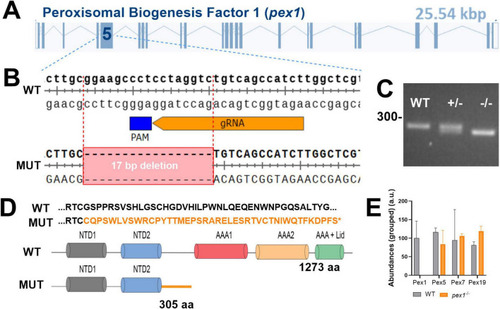
Generation of a pex1 zebrafish model by CRISPR/Cas9. (A,B) Targeting CRISPR sites in exon 5 of the zebrafish pex1 gene induced a 17 bp-deletion leading to a premature stop codon (MUT). (C) PCR on genomic DNA allows genotyping: wild-type (WT, 290 bp), heterozygous, and homozygous mutant (273 bp). (D) Amino-acid sequences of wildtype (WT, 1273 aa) versus mutated Pex1 protein (MUT, 305 aa), which is predicted to lack the AAA-ATPase domains essential for Pex1 function. The altered amino acid sequence resulting from the frameshift mutation is indicated in orange. (E) Proteomics-based analysis of Pex protein levels in livers from 7-month-old WT and pex1–/– zebrafish (data are means ± % CV for n = 3 biological replicates).

EXPRESSION / LABELING:
Genes:
Fish:
Anatomical Term:
Stage: Adult
PHENOTYPE:
Fish:
Observed In:
Stage: Adult

Survival and phenotypic characterization of the pex1 mutant zebrafish line. (A) Survival curves up to 15 days post-fertilization (dpf) (n = 50). (B) Percentage of wild-type (WT), heterozygous (pex1+/–), and homozygous (pex1–/–) mutant offspring reaching adulthood from F2 to F4 generations. (C) For organ morphology characterization, ten and five animals per genotype were dissected at 4 and 10 months, respectively. Representative post-mortem images of WT and pex1–/– female and male fish showing hepatic steatosis already at 4 months. Example of degenerated ovaries [O] and enlarged fatty liver in a 10-month-old female. Testis are indicated by a [T] in 10-month-old males. (D) H&E staining of liver sections from 7-month-old female fish revealed vacuolization in pex1–/– samples (the images are representative of 2 biological replicates). Scale bars represent 100 μm in (C,D).

Peroxisome biogenesis is compromised in adult pex1 zebrafish. (A) Confocal images of 5 μm liver sections from 7-month-old wild-type (WT) and pex1–/– fish stained for catalase (peroxisomal matrix marker) or PMP70 (peroxisomal membrane marker). WT hepatocytes display numerous punctate peroxisomes, whereas pex1–/– cells show a more diffuse catalase staining and fewer PMP70-positive puncta. Representative images were generated using Maximum Intensity Projection of the entire z-stack to enhance peroxisomal contrast. Secondary-antibody-only controls (Alexa488) verify staining specificity. Nuclei were counterstained with DAPI (cyan). Scale bars, 2 μm. (B) Quantification of peroxisome counts using Average Intensity Projection data. Bars represent means ± SD from three biological replicates (one section per fish; n = 3). Unpaired, two-tailed Student’s t-test: *p < 0.05; ns, not significant. (C) Heat-map of indicated fatty acid profiles measured by LC-MS in brain and liver of individual 7-month-old WT, pex1+/–, and pex1–/– fish. The numerical values shown on the right correspond to KO/WT log2 ratios and represent means of 3–4 biological replicates. Crosses on white background indicate missing values. Multiple unpaired Student’s t-test: *p < 0.033, **p < 0.0021, ***p < 0.0002, ****p < 0.0001.

Liver steatosis and lipid dyshomeostasis manifest during early development in pex1 mutant larvae. (A) Brightfield (left) and Oil-Red O (ORO) staining (right) of 13 dpf zebrafish larvae. Robust neutral-lipid accumulation is confined to the liver of pex1–/– larvae compared with wild-type (WT) and heterozygous siblings. Scale bar, 1 mm. (B) Incidence of ORO-positive (steatotic) livers at 13 dpf; n = 20 larvae per genotype. (C) Log2 fold change of pristanic and phytanic acid in pex1–/– versus WT larvae at 13 dpf measured by LC-MS in whole-larva extracts. Bars represent means ± SDs of five independent replicates, each replicate being a pool of five larvae (n = 5). (D) Heatmap of fatty acid (FA) species profiled by LC-MS. Columns represent biological replicates (pools of five larvae at 11 dpf); rows represent individual FAs. The numerical values on the right correspond to KO/WT log2 ratios and statistical significance was assessed with multiple unpaired Student’s t-test: *p < 0.033; **p < 0.0021, ***p < 0.0002, ****p < 0.0001. Crosses on white background indicate missing values. (E) Stacked bar plots of the FA composition of the indicated lipid classes determined by targeted lipidomics at 13 dpf. Data are means ± SDs of five biological replicates (pools of 15 larvae) normalized to DNA content. Statistical significance in panels C,E was assessed with an unpaired Welch’s t-test (WT vs. pex1–/–). *p < 0.033; **p < 0.0021, ***p < 0.0002, ****p < 0.0001.

Transcriptomics analysis of pex1 larvae indicates ER stress, alteration of neurological and visual processes, and dysregulation of bile acid metabolism. (A) Partial Least Squares Discriminant Analysis (PLS-DA) of gene transcripts of 11 dpf WT and pex1–/– larvae. Each dot represents a single biological replicate of a pool of ten WT (gray) or pex1–/– (orange) larvae. (B) Volcano plot showing significantly altered genes (adj. p-value < 0.01) in red, strongly downregulated genes (log2FC ≤ –1.5) in gray, and strongly upregulated genes (log2FC ≥ + 1.5) in blue. (C) Summary bar plot of the number of DEGs identified by the transcriptomics analysis. (D) qPCR validation of selected DEGs identified by RNAseq. All expression levels in pex1–/– larvae are shown relative to WT levels. (E) Dot plot showing cellular process networks significantly enriched in differentially expressed genes. Dot position along the x-axis represents -log10(minFDR) values, with dots further right indicating higher statistical significance as measured by the false-discovery rate (FDR). Dot size reflects the number of genes found in each process, and color intensity indicates significance level. Processes related to protein folding and endoplasmic reticulum stress pathways show the strongest enrichment signals.

EXPRESSION / LABELING:
Genes:
Fish:
Anatomical Term:
Stage: Days 7-13
PHENOTYPE:
Fish:
Observed In:
Stage: Days 7-13

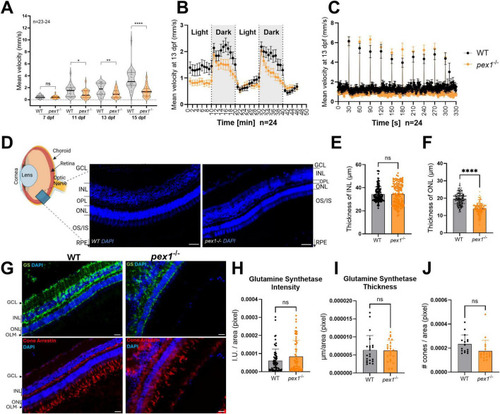
Pex1 deficiency leads to behavioral changes in larvae and perturbed retinal architecture in adult fish. (A) The total mean velocity of 7, 11, 13, and 15 dpf larvae was recorded under constant light conditions for 1 hr. Each dot represents the mean velocity of one larva (n = 23–24). (B) Behavioral profiles (1-min intervals) of 13 dpf larvae under alternating light/dark conditions in 10-min interval cycles. (C) Startle response profile (1-sec intervals) of 13 dpf larvae upon acoustic stimuli applied in 30-sec intervals. Each dot in (B,C) represents the mean velocity (± SEM) of 24 larvae recorded on two independent plates. Statistical significance in (A) was determined by unpaired t-test (*p < 0.033; **p < 0.0021, ****p < 0.0001). (D) Zebrafish eye representation showing DAPI counterstaining of nuclei (blue) across the retinal layers—GCL, INL, OPL, and ONL—in 7-month-old animals. Scale bars represent 10 μm. (E,F) Six measurements were taken from six images per eye, with three images on each side of the optic nerve. For each side, these three images were positioned equidistant from the optic nerve. Each dot represents an individual measurement. Values are presented as means ± SDs; statistical analysis was performed using an unpaired t-test (****p < 0.0001). (G) Glutamine synthetase (GS; green) and cone arrestin (red) immunostaining highlighting Müller glial and cone cells, respectively. Scale bars represent 5 μm. (H,I) Quantification of Müller cell fluorescence intensity and cell layer thickness (μm) normalized to Müller cell area (operationally defined as the area within the retinal section that shows positive GS labeling). Measurements were taken from three images lateral to the optic nerve on both left and right sides (6 images/eye). The Müller cells were delineated based on GS staining from the outer limiting membrane to the inner nuclear layer. Each dot represents a single measurement. (J) Normalized cone density (number of cones/area). Cones were automatically identified using a custom Matlab script, with manual correction for overlapping signals. Each dot represents one single image taken from three images lateral to the optic nerve, as described above. For (H–J), means ± SDs are shown and statistical analysis was performed using an unpaired t-test (ns, non-significant). Three (E,F) or four (H–J) eyes from different animals were analyzed per genotype. GCL, ganglion cell layer; INL, inner nuclear layer; OPL, outer plexiform layer; ONL, outer nuclear layer; OS/IS, outer/inner segment; RPE, retinal pigment epithelium; GS, glutamine synthetase; OLM, outer limiting membrane; I.U., intensity units.

EXPRESSION / LABELING:
Antibodies:
Fish:
Anatomical Terms:
Stage: Adult
PHENOTYPE:
Fish:
Observed In:
Stage Range: Days 7-13 to Adult

Schematic overview of the main phenotypic outcomes observed in the pex1 ZSD zebrafish model, based on characterization through lipidomics, transcriptomics, histochemical immunostaining, and locomotor behavioral assays.

Acknowledgments
This image is the copyrighted work of the attributed author or publisher, and ZFIN has permission only to display this image to its users. Additional permissions should be obtained from the applicable author or publisher of the image. Full text @ Front. Mol. Neurosci.