FIGURE SUMMARY
Title

An mTOR-Tfeb-Fabp7a Axis Ameliorates bag3 Cardiomyopathy via Decelerating Cardiac Aging

Authors
Ding, Y., Ma, X., Yan, F., Yoon, B., Wei, W., Zhang, Y., Lin, X., Xu, X.
Source
Full text @ Aging Cell

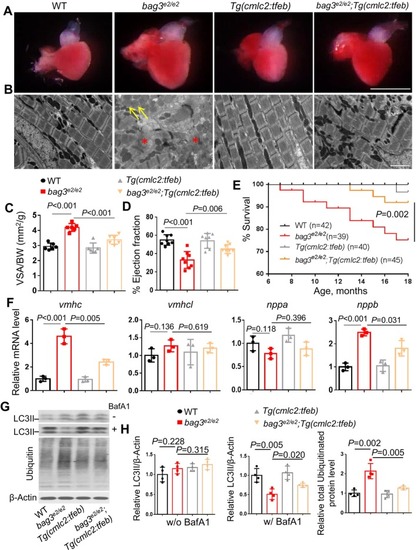
Cardiomyocyte‐specific overexpression of tfeb alleviated bag3 cardiomyopathy phenotypes and restored impaired proteostasis. (A–C) Bright‐field images of dissected hearts (A) confirmative images of transmission electron microscope (TEM) (B) and quantification analysis (C) show enlarged ventricular surface area (VSA) normalized to body weight (BW), impaired sarcomere structure (Asterisks), and mitochondrial swelling (Arrows) phenotypes in the bag3e2/e2 mutant hearts, which were ameliorated by Tg(cmlc2:tfeb), a cardiomyocyte‐specific tfeb overexpression transgenic line. Scale bars in A, 1 mm; in B, 20 μm. (D, E) Ejection fraction (EF) (D) and Survival (in %) (E) of bag3e2/e2; Tg(cmlc2:tfeb) double mutant/transgenic fish compared to the bag3e2/e2 single mutant, Tg(cmlc2:tfeb) single transgenic or WT control fish; n = 39–45, log‐rank test. (F) Quantitative RT‐PCR analysis of cardiomyopathy molecular markers in bag3e2/e2; Tg(cmlc2:tfeb) double mutant/transgenic fish compared to single‐mutant/transgenic fish and WT control fish. n = 3 biological replicates, one‐way ANOVA. (G–H) Western blot (G) and quantification analysis of the LC3 II and ubiquitinated proteins in indicated fish heart treated with or without 50 nM bafilomycin A1 (BafA1) for 4 h. n = 4 biological replicates, one‐way ANOVA.

Cardiomyocyte‐specific overexpression of tfeb decelerated cardiomyocyte senescence. (A, B) Representative images of cryosectioned heart tissues co‐immunostained using either anti‐p16 antibody co‐stained with anti‐Mef2 antibody (A) or anti‐γH2A antibody co‐stained with anti‐α‐actinin antibody (B) in the bag3e2/e2; Tg(cmlc2:tfeb) double‐mutant/transgenic fish compared to single‐mutant/transgenic fish and WT control fish at 6 months. Scale bars: 20 μm. Arrows point to overlapping signals. (C, D) Quantification of the numbers of p16/Mef2 and γH2A.X/α‐actinin antibodies co‐immunostained cells shown in A and B. n = 5, One‐way ANOVA. (E–H) Quantitative RT‐PCR analysis of cellular senescence marker p21 and senescence‐associated secretory phenotype (SASP) markers in bag3e2/e2; Tg(cmlc2:tfeb) double mutant/transgenic fish compared to single‐mutant/transgenic fish and WT control fish. n = 3 biological replicates, one‐way ANOVA.

Combination of RNA‐seq with an F0‐based genetic screen identified fabp7a as a therapeutic modifier gene for the bag3 cardiomyopathy model. (A, B) Principal Component Analysis (PCA) of RNA‐seq‐based expression data from the mtorxu015/+ mutant (A) or Tg(cmlc2:tfeb) (B) transgenic fish hearts compared to WT controls. (C) 3D PCA plot using the normalized gene expression of all expressed genes to assess the genome‐wide transcriptomic similarity among mtorxu015/+ mutant, Tg(cmlc2:tfeb) transgenic fish hearts, and WT controls. (D) Comparison of cardiac transcriptome between mtorxu015/+ mutant and Tg(cmlc2:tfeb) transgenic fish hearts identified 10 upregulated and 15 downregulated genes as common DEGs. (E) Quantitative RT‐PCR validated the expression of 4 lipodystrophic DE genes that were downregulated in both the mtorxu015/+ mutant and the Tg(cmlc2:tfeb) transgenic hearts. (F) List of single guide RNA (sgRNA) sequences for the 4 lipodystrophic DE genes and knockout scores detected from the adult fish injected with sgRNAs in F0 generation. (G) Injection of fabp7a microhomology‐mediated end joining (MMEJ)‐inducing sgRNA, but not the other 3 individual MMEJ sgRNAs, exerts a cardioprotective effect on bag3e2/e2 cardiomyopathy in F0 adult fish.

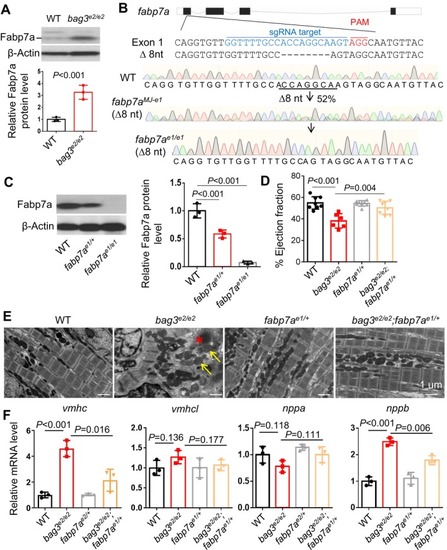
The therapeutic modifying effects of fabp7a inhibition were validated in the stable F1 haploinsufficiency mutant. (A) Western blot and quantification analysis of the Fabp7a protein levels in heart lysates of bag3e2/e2 mutant compared to WT control fish hearts at 6 months. (B) Schematic and chromatographs illustrating the genetic lesion of 8 nucleotides generated by injection of an MMEJ inducing fabp7a sgRNA targeting sequences within the first exon. Dashed lines indicate an 8‐nucleotide‐long deletion. (C) Western blot and quantification analysis of the Fabp7a protein levels in the fabp7a stable heterozygous (fabp7ae1/+) and homozygous (fabp7ae1/e1) mutant fish compared to WT controls. n = 3, one‐way ANOVA. (D) Quantification of cardiac function. Ejection fraction (EF) (in %) measured by echocardiography in bag3e2/e2; fabp7ae1/+ double mutant fish compared to single mutant and WT control fish at 6 months; n = 6–8, one‐way ANOVA. (E) Confirmative TEM images of bag3e2/e2; fabp7ae1/+ double mutant fish hearts compared to bag3e2/e2 and fabp7ae1/+ single mutant and WT controls at 6 months. The asterisk indicates Z‐disc aggregation. Arrows point to mitochondrial rounding and swelling. Scale bar: 2 μm. (F) Quantitative RT‐PCR analysis of cardiomyopathy molecular markers in bag3e2/e2; fabp7ae1/+ double mutant fish compared to single mutant and WT control fish at 6 months. n = 3 biological replicates, one‐way ANOVA.

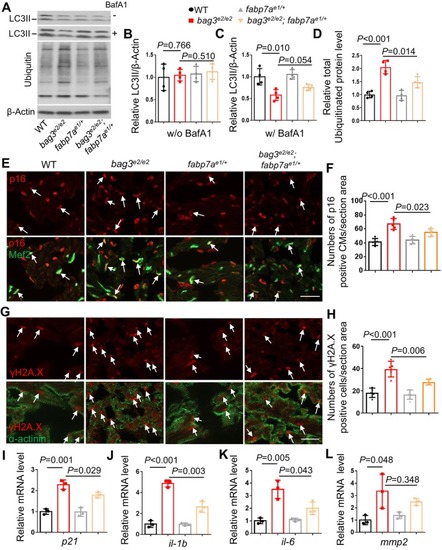
fabp7a inhibition is sufficient to restore impaired protein homeostasis and decelerate cardiomyocyte senescence in the bag3 cardiomyopathy model. (A–D) Western blot (A) and quantification analysis of LC3II with (B) or without (C) BafA1 treatment, and ubiquitinated protein (D) levels in heart lysates of bag3e2/e2; fabp7ae1/+ double‐mutant, bag3e2/e2, fabp7ae1/+ single mutant, or WT control fish hearts at 6 months treated with or without 50 nM BafA1 for 4 h. n = 4, one‐way ANOVA. (E, F) Representative images of immunostaining (E) and quantification of the numbers of p16/Mef2 signal (F) in cryosectioned heart tissues co‐stained with anti‐p16 and anti‐Mef2 antibodies. G‐H, Representative images of immunostaining (G) and quantification of the numbers of γH2A.X/α‐actinin signal (H) in cryosectioned heart tissues co‐stained with γH2A.X and anti‐α‐actinin antibodies (G) in bag3e2/e2; fabp7ae1/+ double‐mutant, bag3e2/e2, fabp7ae1/+ single mutant, or WT control fish hearts at 6 months. Arrows point to overlapping signals. Scale bars: 20 μm. n = 5, one‐way ANOVA. (I–L) Quantitative RT‐PCR analysis of cellular senescence marker p21 and SASP markers in bag3e2/e2; fabp7ae1/+ double‐mutant compared to single‐mutant fish and WT control fish hearts at 6 months. n = 3 biological replicates, one‐way ANOVA.

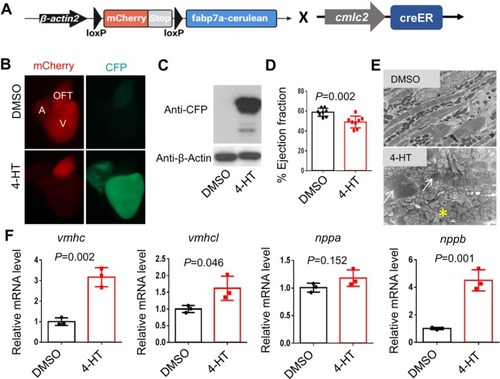
Cardiomyocyte‐specific overexpression of fabp7a gene results in cardiac dysfunction. (A) Schematic constructs and design to generate a transgenic line with cardiomyocyte‐specific overexpression of fabp7a in zebrafish. (B, C) Cardiomyocyte‐specific overexpression of Fabp7a was indicated by fluorescence switch from mCherry to cerulean fluorescent protein (CFP) (B) and by Western blot analysis (C) at one week post‐4‐Hydroxytamoxifen (4‐HT) induction. (D, E) Cardiomyocyte‐specific overexpression of Fabp7a led to cardiac function decline (D) impaired sarcomere (arrows) and swollen mitochondria (asterisk) (E) at 3 months post‐4‐HT induction. (F) Quantitative RT‐PCR analysis of cardiomyopathy molecular markers in the cardiomyocyte‐specific overexpression of Fabp7a fish at 3 months post‐4‐HT induction. n = 3 biological replicates, one‐way ANOVA.

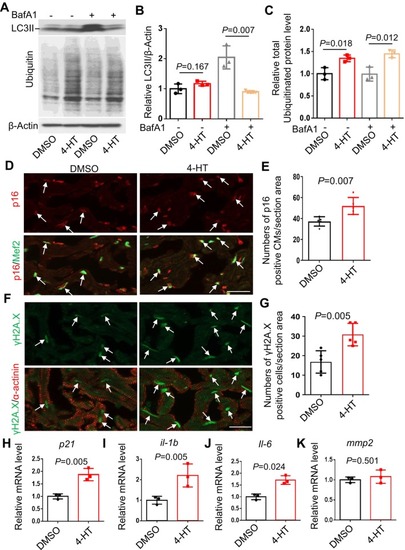
Cardiomyocyte‐specific overexpression of fabp7a gene caused impaired protein homeostasis and accelerated cellular senescence. (A–C) Western blot (A) and quantification analysis of the LC3 II (B) and ubiquitinated proteins (B) levels indicated fish heart treated with or without 50 nM BafA1 for 4 h. n = 3 biological replicates, one‐way ANOVA. (D, E) Representative images of immunofluorescence using anti‐p16 antibody co‐stained with anti‐Mef2 antibody (D) and quantification of the numbers of anti‐p16/anti‐Mef2 signal (E) in the cardiomyocyte‐specific overexpression of Fabp7a fish at 3 months post‐4‐HT induction. Arrows point to overlapping signals. Scale bars: 20 μm. n = 5, one‐way ANOVA. (F, G) Representative images of immunofluorescence using anti‐γH2A.X antibody co‐stained with anti‐α‐actinin antibody (F) and quantification of the numbers of anti‐γH2A.X/anti‐α‐actinin co‐stained cell signal (G) in the cardiomyocyte‐specific overexpression of Fabp7a fish at 3 months post‐4‐HT induction. Scale bars: 20 μm. n = 5, one‐way ANOVA. (H–K) Quantitative RT‐PCR analysis of cellular senescence marker p21 and SASP markers including il‐1b, il‐6, and mmp2 in the cardiomyocyte‐specific overexpression of Fabp7a fish at 3 months post‐4‐HT induction. n = 3 biological replicates, one‐way ANOVA.

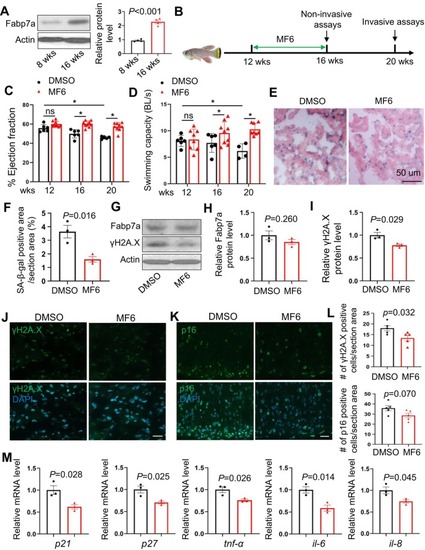
MF6 treatment decelerated cardiac aging indices during normative aging in the turquoise killifish. (A) Representative Western blot and quantification analysis of the Fabp7a protein expression in 8‐week‐old versus 16‐week‐old killifish. n = 4, Student t‐test. (B) Schematics of the schedules for Fabp7 inhibitor (MF6) treatment from 12‐week‐old to 16‐week‐old killifish. MF6 was delivered once the other day by oral gavage. Non‐invasive assays refer to in vivo phenotyping methods that live fish can tolerate and survive, such as echocardiography and swimming capacity measurement. Invasive assays involve phenotyping methods that require sacrificing the fish to isolate tissues or organs for histological, molecular, and cellular analyses. (C) Ejection fraction (EF, %) quantification in turquoise killifish treated with MF6 (Fabp7a inhibitor, Fabp7‐i) or DMSO control, measured at 12, 16, and 20 weeks of age, showing significantly preserved cardiac function in the MF6‐treated group at 16 and 20 weeks of age. n = 5–8, two‐way ANOVA. ns, not significant. *, p < 0.05. (D) Swimming capacity assessed as body length per second (BL/s), demonstrating improved physical endurance in MF6‐treated fish at 16 and 20 weeks of age. n = 4–8, two‐way ANOVA. ns, not significant. *p < 0.05. (E, F) Representative images (D) and quantification (E) of senescence‐associated β‐galactosidase (SA‐β‐gal) activity staining in the MF6‐treated hearts compared to the DMSO controls at 20 weeks. Scale bar, 50 μm. n = 3, Student t‐test. (G–I) Representative western blot images (G) and quantification of the Fabp7a (H) and γ‐H2A.X (I) protein levels in the MF6 treated killifish hearts compared to DMSO control. n = 3, Student t‐test. (J–L) Representative images of γ‐H2A.X (J) and p16 (K) antibody immunofluorescent staining and quantification of γ‐H2A.X‐positive and p16 cell numbers (L) in the MF6‐treated killifish hearts compared to DMSO. Scale bars, 20 μm. n = 5, Student t‐test. (M) Quantitative RT‐PCR analysis of cellular senescence markers p21 and p27 and SASP markers including tnf‐α, il‐6, and il‐8 in the MF6 killifish hearts compared to DMSO control. n = 3 biological repeats, student t test.

Acknowledgments
This image is the copyrighted work of the attributed author or publisher, and ZFIN has permission only to display this image to its users. Additional permissions should be obtained from the applicable author or publisher of the image. Full text @ Aging Cell