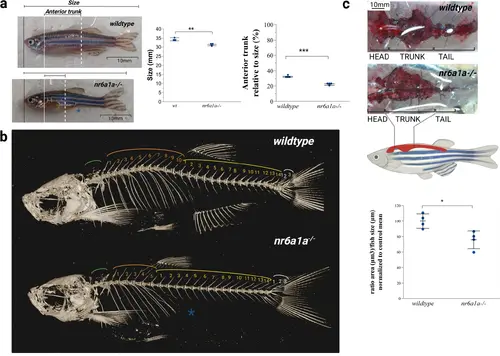
Smaller size, decreased number of rib-bearing vertebrae and abnormal size and morphology of the kidney in nr6a1a−/− adult zebrafish. a Comparison of the size of wildtype (n = 3) and mutant (n = 3) siblings at 5-month ½ (mean size wildtype: 34.295 mm; mean size mutants:31.125 mm;difference: 3.17 mm (CI 95% 1.47–4.87) (p value = 0.0095)). Comparison of the length of the anterior part of the trunk relative to the fish size between wildtype (n = 4) and mutants (n = 4) (mean ratio wildtype: 32.048%; mutants:22.036%; difference: 10.01% (CI 95% 8.43–11.59) (p value < 0.0001)). b X-ray microtomography of 3-month-old wildtype and mutant. The number of rib-bearing precaudal vertebrae (orange) is decreased in mutants (#5 instead of 10 in wildtype). The rib-bearing precaudal vertebrae are recognizable by the presence of ribs, and the absence of hemal arches and spines, that are them specific of the caudal vertebrae (Bird and Mabee 2003). The number of caudal vertebrae (yellow, and light blue for the caudal fin vertebrae) is normal in mutants (#17). The anal fin (beginning at the 1 st caudal vertebrae in wildtype) is absent in mutant (*). The Weberian vertebrae (vertebrae 1 to 4) are highlighted in green and seems normal although not investigated in details. c Mesonephros morphology of 15-month-old wildtype and mutants. The mutants present an abnormal shape of the mesonephros, dissected after injection of Rhodamine-dextran for visualization. Compared to wildtype (n = 4), the surface of the mesonephros relative to the fish size (after normalization by the control mean), is decreased by 24.35% (CI 95% 6.15–42.54) (p value = 0.017) in nr6a1a-/- mutants (n = 4).
|