
FIGURE 1
- ID
- ZDB-FIG-260520-73
- Publication
- Ononuju et al., 2026 - Employing zebrafish to understand genetic drivers of epilepsy-related comorbid behaviors
- Other Figures
- All Figure Page
- Back to All Figure Page
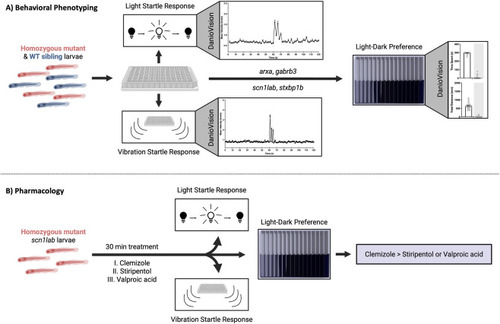
Behavioral phenotyping and pharmacological testing workflow in larval zebrafish. (A) Larval zebrafish lines (6 dpf) were subjected to light-evoked and vibration-induced startle assays in a 96-well format using DanioVision tracking, and a subset was subsequently assessed in a light-dark preference assay. (B) Homozygous scn1lab larvae were treated for 30 min with clemizole, stiripentol, or valproic acid, followed by startle and light-dark preference assays to assess behavioral rescue. Startle plots show mean velocity responses of WT (TL) larvae to light (three on-off pulses) and vibration (three taps) stimuli, with stimulus onset at 60 s. Light-dark preference plots show WT behavior under 20% light intensity, quantified by time spent (s) and total distance traveled (mm) in light versus dark (shaded gray) arenas. Data are presented as mean ± SEM (n = 60–70). Created with BioRender. |