
Figure 1
- ID
- ZDB-FIG-260311-719
- Publication
- Keeley et al., 2026 - Differential fates of Kazald gene quartet: Ancestral roles in skeletogenesis and regeneration to putative innovations in fish and birds
- Other Figures
- All Figure Page
- Back to All Figure Page
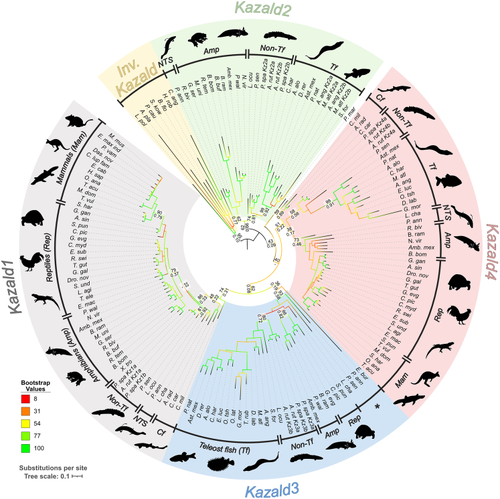
Phylogenetic tree of Kazald genes reveals that all vertebrate genes are split into four distinct clades Displayed consensus tree was generated via RAxML using amino acid sequences. Branch colors reflect the bootstrap values of each node, and do not correspond to branch support. Support values are shown at several key evolutionary nodes, e.g., at the base of mammals, amniotes, and teleost fish, or when the values between maximum likelihood (ML) and Bayesian inference (BI) trees differ considerably. Layout of the support values is: ML bootstrap support via RAxML (top), BI posterior probabilities via BAli-Phy (bottom). Species are grouped into major categories within each Kazald gene clade. Inv. = invertebrates, NTS = non-tetrapod sarcopterygians, Cf. = cartilaginous fish, Non-Tf = non-teleost ray-finned fish. ∗ marks a polyphyletic grouping containing a jawless vertebrate, two non-tetrapod sarcopterygians, and one non-teleost ray-finned fish. Abbreviated species names are listed in |