FIGURE

Figure 3

ID
ZDB-FIG-260311-721
Publication
Keeley et al., 2026 - Differential fates of Kazald gene quartet: Ancestral roles in skeletogenesis and regeneration to putative innovations in fish and birds
Other Figures
All Figure Page
Back to All Figure Page
Figure 3

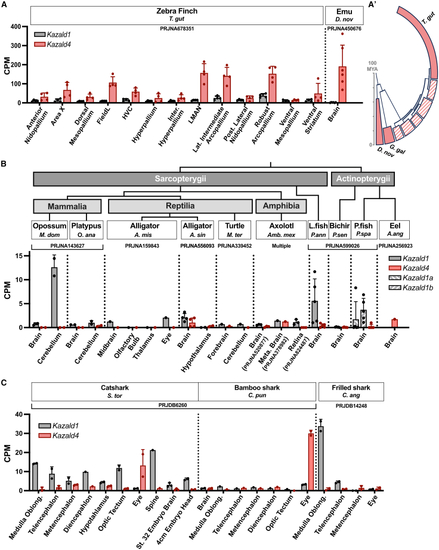
Kazald4 is highly expressed in avian brains, but not in the brains of other species

(A) Quantification of Kazald gene expression in different parts of the zebra finch brain and in the whole emu brain.

(A′) shows a simplified evolutionary tree of birds (based on49); clades containing species shown to express Kazald4 in the brain are filled in, while remaining clades have a striped pattern.

(B) Quantification of Kazald1 and Kazald4 gene expression in the brains and retinas of non-avian osteichthyans. A simplified overview of the evolutionary relationships of the examined species is displayed above the gene expression graph. Kazald1 was duplicated in the lineage leading to paddlefish (P.fish) with no subsequent loss, creating Kazald1a and Kazald1b. L.fish = Lungfish.

(C) Quantification of Kazald gene expression in different parts of the brain and associated neural tissues of several chondrichthyans. PRJ IDs indicate the publicly available RNA-Seq datasets that generated the raw data for the listed tissues. Dots represent biological replicates in examined datasets, and error bars represent standard deviation when calculable. CPM = counts per million. Data are represented as Mean ± SD.

Expression Data

Expression Detail
Antibody Labeling
Phenotype Data

Phenotype Detail
Acknowledgments
This image is the copyrighted work of the attributed author or publisher, and ZFIN has permission only to display this image to its users. Additional permissions should be obtained from the applicable author or publisher of the image. Full text @ iScience