
Figure 2
- ID
- ZDB-FIG-260311-720
- Publication
- Keeley et al., 2026 - Differential fates of Kazald gene quartet: Ancestral roles in skeletogenesis and regeneration to putative innovations in fish and birds
- Other Figures
- All Figure Page
- Back to All Figure Page
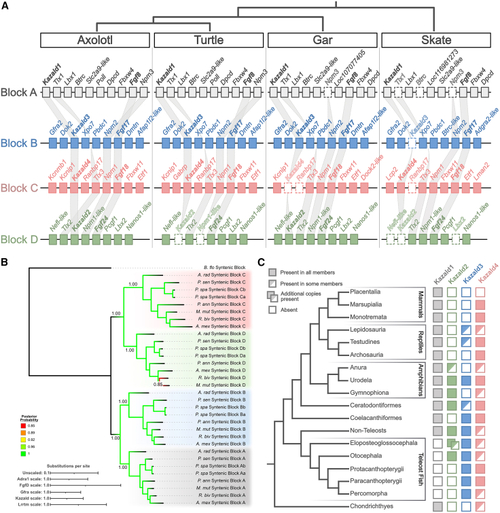
Conserved intra-/intergenomic synteny analysis supports the origin of the Kazald gene family in the 2R-WGD event ancestral to jawed vertebrates (A) Illustration of the syntenic blocks containing the Kazald genes in four representative species. Various paralogous genes are connected via gray lines. Genes lost in a species are drawn with a dotted outline and no internal color. Kazald genes are bolded. Fgf genes were used as the syntenic block anchor when a Kazald gene was absent, and thus are also bolded. (B) Consensus tree generated via BAli-Phy partitioned analysis using the amino acid sequences of the five listed gene families (see also (C) Simplified diagram of individual Kazald gene maintenance across vertebrates, along with the relationships of the different lineages. Colors of Kazald genes and the syntenic blocks correspond to each other. Dual boxes for |